
Announcing - Connecting Students from Gaza with Internships in the UK and Ireland
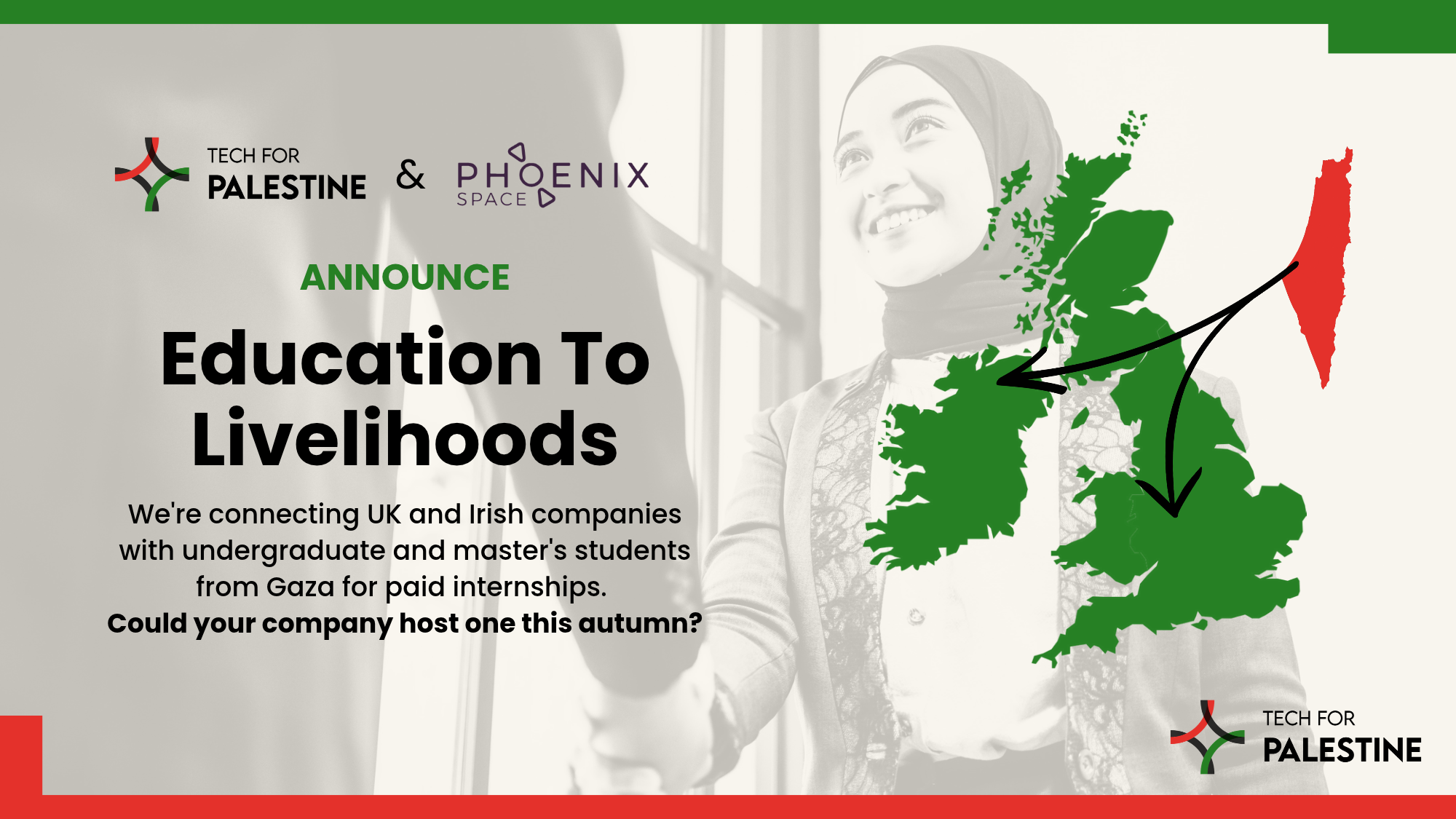
Tech for Palestine is now helping students from Gaza who are studying in the UK and Ireland find paid internships. Since 2025, Phoenix Space has helped 230 students leave Gaza and start university in the two countries, and many are now graduating with top honors. But a good degree doesn't come with a network, local work experience, or a reference, and those are often what get you a first job.
We're building this together: Phoenix Space knows the students and their needs, and our volunteers bring the tech, recruiting and employer connections to match them with internships value-aligned employers from the T4P network and beyond.
A First-Class Degree and No Way In
The past two and a half years have taken more from these students than most of us can imagine. They kept studying through it, far from home, and many are now finishing degrees at good universities with excellent results.
The next step is harder. Graduate jobs ask for experience, and experience usually starts with an internship. Internships often go to people who know someone. A student who arrived in a new country a year or two ago is still building that circle, and talent alone rarely gets a CV onto the right desk.
Going home to look for work isn’t an option, so that first job matters more than usual. It starts a career, and over time, builds the skills and networks Gaza will need when rebuilding becomes possible.
How It Works
Phoenix Space helped these students leave Gaza and go onto university. As Kamil Mousselli, who leads their Gaza support work, puts it: “We realised that graduation cannot be the finish line.” Their Education to Livelihoods program is the answer to that, and finding employers is where we come in. Phoenix Space knows the students: their degrees, their skills, and what they hope to do next. We reach out to the companies, starting with businesses in our own network and going further from there.
For a company, it’s simple:
- You tell us about a role: the title, hours, timeline, and what the work involves.
- Phoenix Space picks students who fit and sends you their CVs.
- You interview at your own pace and choose.
- You hire your intern directly and pay them. Internships are in person, part-time or full-time, for three months or longer.
- Where it helps, students get a mentor for the placement.
Every internship is paid at least minimum wage. These students are rebuilding their lives from the ground up, and their time and skills deserve to be paid.
What Happened This Summer
This summer, four UK companies hired interns from Gaza. Two of the employers told us how it went:
“Hiring a student from Gaza was straightforward and genuinely valuable for the business. Every applicant was excellent, and we were able to run the process at our own pace. The placement brought real skills into our team, and we’d happily do it again.”
Jon Stutfield, CEO of Bliss
“I was grateful to learn that this programme existed. Providing opportunities for highly talented young people from Gaza is a privilege and I’m glad that we were able to help in a small way by offering this internship. All of the candidates in the programme were of a very high calibre and it was a great success.”
Taliesen Hollywood, Hahnbeck
Now more than 100 students are looking for placements, studying everything from AI, software and cybersecurity to medicine, engineering, business and law.
Take On an Intern
If your company is in the UK or Ireland and could make room for an intern for three months, tell us about the role, and we’ll take care of the matching.
Not hiring yourself? Forward this to whoever does hiring where you work.
This is a new way of working for us: a nonprofit's team and our volunteers building a project together. If your organization has a project that could work like this, write to partnerships@techforpalestine.org.